In horse racing, technology is often assessed through the lens of performance: measuring training more accurately, monitoring fitness, or simply having access to more data.
But for a trainer, another question is just as important:
What is the real return on investment of these technologies for my stable?
A sensor does not win races. It does not replace the trainer’s experience, the rider’s feel, or the veterinarian’s expertise.
Its value lies elsewhere: providing objective information that can help trainers make better-informed decisions, earlier and more consistently.
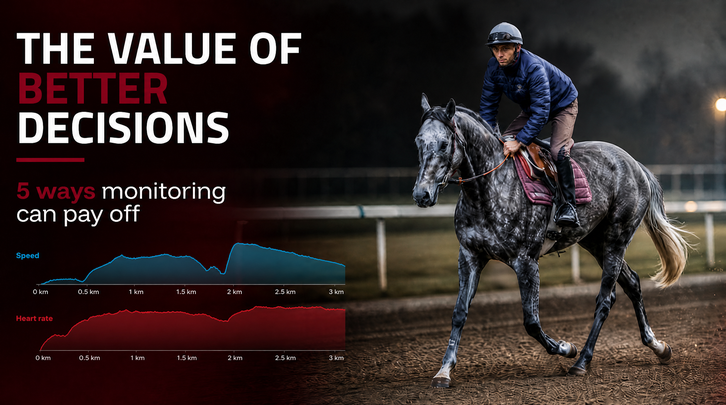
Heart rate, ECG, speed, GPS, recovery, stride length and stride frequency: when monitored over time, the data collected by equine wearables can have an impact not only on sporting performance, but also on the economics of running a stable.
Here are 5 ways regular use of the Arioneo Equimetre Training System can generate a return on investment for a racehorse training operation.
1. Avoid entering or travelling with a horse at the wrong time
Running a horse represents an investment.
Transport, entry fees, staff, travel and logistics can quickly add up to hundreds or even thousands of dollars.
But the most significant cost is not necessarily financial. A race also represents a major physical effort for the horse, as well as several days of preparation and recovery.
Data collected during the horse’s most recent training sessions can provide an additional layer of information before making an entry: unusual recovery, a different heart rate response, lower performance during a comparable exercise, or changes in locomotion parameters.
This does not necessarily mean the horse should not race.
But it may give the trainer an additional reason to investigate before making the decision.
“It gives me confidence to enter the horse in a race, and have confidence if they’re fit and ready to run.”
|
Potential return on investment: avoiding just one race or unnecessary trip at the wrong time can represent several months of monitoring costs. |
2. Keep horses available for longer
For a racing stable, one of its most valuable assets is the number of days its horses are available to train and race.
A horse that is out of training continues to generate costs while losing opportunities to train and compete.
One of the main benefits of longitudinal monitoring is the ability to progressively build an individual reference for each horse.
When comparing similar training sessions:
- Is the horse’s cardiovascular system working harder?
- Is it recovering as quickly?
- Is its locomotion changing?
- Is it producing the same speed for a comparable level of effort?
- Is it responding in the same way it did a few weeks ago?
The Arioneo Equimetre Training System does not diagnose medical conditions.
However, identifying that a horse is no longer responding exactly as usual can encourage the team to investigate, adapt the training program, or seek veterinary advice.
The same principle can help trainers manage workload more effectively.
If a horse progressively completes the same exercise with better recovery, a lower heart rate or greater efficiency, these indicators can help confirm that the training program is producing the desired adaptations.
And sometimes, the best decision is simply not to ask for more.
>> Read the article on the different pathologies in racehorses
|
Potential return on investment: preserving even a few days or weeks of availability, or avoiding additional work with limited marginal benefit, can have an economic value far greater than the cost of monitoring. |
3. Better understand and develop young horses
Young horses are probably one of the areas where longitudinal monitoring can deliver the greatest value.
At the beginning of their careers, every training session provides another opportunity to understand their individual profile.
By collecting data early, a stable can progressively build an individual baseline and monitor:
- cardiovascular response to exercise,
- recovery,
- speed,
- locomotion,
- fitness progression,
- stride length and stride frequency,
- and the overall evolution of the horse’s profile.
Most importantly, the young horse can be compared with the most relevant reference: itself a few weeks or months earlier.
For a stable with a large number of two-year-olds, this can also help identify which horses are progressing quickly and which may need more time.
Wearable data can provide additional information about how a horse generates speed, how long it can maintain it, and how its locomotion profile evolves over time.
These insights can contribute to the trainer’s decisions around training programs, work groups, and potentially the distances towards which a horse should progressively be oriented.
“We can have two horses on the same training program, but in terms of recovery, training results, and progression, they can fall into two completely different categories. It really helps us make decisions, for example about what we’re going to do the following week, how fast we’re going to progress the horse, or whether we should ease off a bit and work more on fitness.”
| Potential return on investment: individualising progression and understanding a young horse’s profile earlier can reduce the need to wait for several races before adjusting its program. |
4. Create more value for owners
The return on investment of an equine wearable is not limited to what happens on the training track.
It can also improve the relationship between trainers and owners.
Owners rarely see their horses train every morning. Being able to show them how speed, recovery or fitness is progressing, or share data from key training sessions, adds another dimension to the conversation.
It can help trainers explain why they are increasing the workload, why they are giving a horse more time, why a target has changed, or why they believe the horse is ready to race.
Data does not replace the trainer’s analysis.
It provides additional material to explain and illustrate the work being done with the horse.
“It’s also very useful for communicating with owners. Showing them precise, visual statistics is more convincing than a simple verbal update. They appreciate seeing the progress in black and white.”
|
In an increasingly competitive environment, this transparency can help differentiate a stable and strengthen long-term owner relationships. Potential return on investment: improving the owner experience can contribute to retention. Retaining just one important owner can represent considerable value for a racing stable. |
5. Turn stable data into a long-term asset
This is probably the least immediate return on investment, but potentially one of the most valuable.
A stable using equine wearables over several years is not simply collecting data on individual horses.
It is progressively building its own knowledge base.
How did the stable’s best horses develop?
What did their data look like as two-year-olds?
Which locomotion profiles are found among horses performing over particular distances?
How does recovery evolve throughout a preparation?
Which types of training sessions produce the desired responses?
One particularly valuable example is to look back at the historical data of a horse that is performing at a high level today and ask: what did its profile look like when it was two?
Those references can then provide additional context when assessing the next generation of young horses.
After several seasons, hundreds of horses and thousands of training sessions, this history progressively becomes a digital memory for the stable.
The trainer’s experience remains central, but part of that experience can now be measured, compared and passed on.
“Over the past five years, we’ve recorded data from Melbourne Cup, Caulfield Cup, Everest, and Cox Plate winners. Having that historical data is a massive advantage. It allows us to go back, review the parameters of our elite performers, and refine our training processes moving forward. We aren’t just guessing; we are benchmarking against the best.”
“After two years of using Equimetre, we’ve gathered so much reference data that I now know exactly which parameters to look for in our horses.”
|
Potential return on investment: turning years of training data into a proprietary asset for the stable that can be used to inform decisions for future generations of horses. |
The return on investment does not come from the sensor. It comes from the decisions.
It would be misleading to claim that a wearable directly helps a stable win more races or prevent injuries.
Racehorse performance and health are far too complex for such a simple relationship.
The return on investment should be considered differently.
Over the course of a season, a trainer makes hundreds of decisions:
Should we increase the workload?
Is the horse ready?
Should it race?
Over what distance?
Is there something we should investigate?
Has it recovered sufficiently?
Does it need more time?
Technology does not need to improve every one of these decisions to deliver a return.
A few better-informed decisions can be enough.
That is precisely the philosophy behind the Arioneo Equimetre Training System: combining cardiovascular and ECG data, GPS, speed and locomotion to provide racing professionals with an objective view of how each horse responds to training, while leaving the final decision with the people who know the horse best.
Ultimately, perhaps the question is not:
“How much does it cost to monitor my horses?”
But rather:
“Over the course of a season, what is the value of making a few key decisions with the right additional information at the right time?”