
A horse can win a race, appear to be in the peak of health at the yard, and simultaneously present an undiagnosed atrial fibrillation, a subclinical gait asymmetry, or micro-tendon lesions that worsen with every training session. This is the fundamental paradox of equine sports medicine: the most dangerous conditions develop in silence.
The Arioneo Equimetre Training System collects physiological and locomotor data in real conditions at every training session: ECG, heart rate, stride symmetry and regularity, and more. This continuous data stream enables three distinct levels of action: detecting an anomaly as it occurs, anticipating an injury before it presents clinically, and objectively monitoring recovery.
1. Cardiac conditions
The racehorse’s heart can generate a cardiac output exceeding 300 L/min at full effort. Its defining characteristic: cardiac anomalies are often completely silent at rest. A horse may present with atrial fibrillation and appear entirely normal in the stable, it is under exertion that the condition reveals itself, and that is precisely when the Arioneo Equimetre Training System captures the necessary data.
Atrial fibrillation, the most clinically significant arrhythmia, reduces cardiac output by 20 to 25% at effort (Consensus adopted by the ACVIM). It can go undetected on a resting ECG yet be clearly visible during a training gallop. Myocarditis, meanwhile, progressively degrades post-effort cardiac recovery over several weeks, a signal that is virtually impossible to objectify without regular individual data.
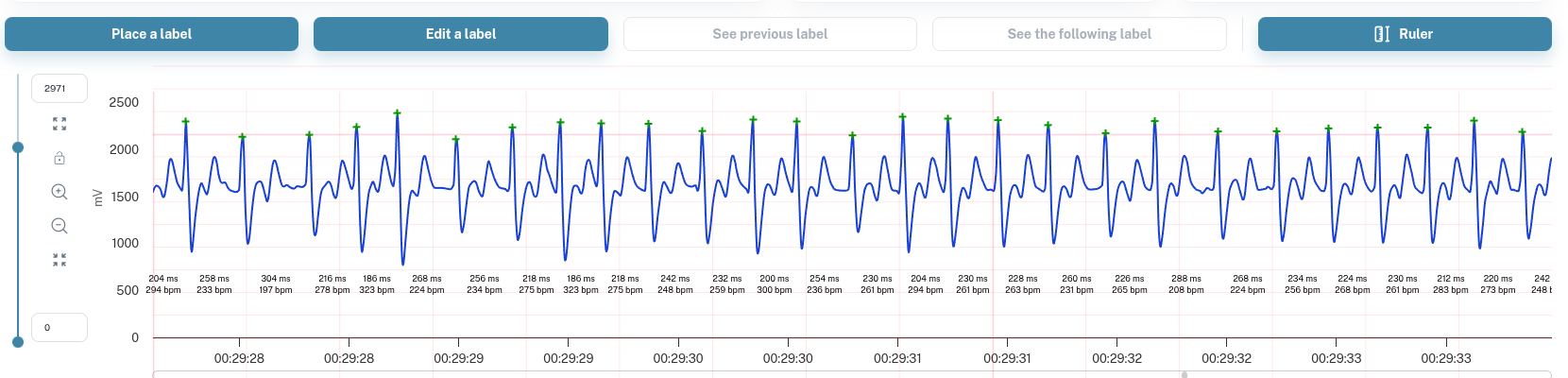
Example of an atrial fibrillation – Arioneo Vet Platform
Two recent studies make the case clearly. In Hong Kong, researchers analysed ECG recordings from 71 Thoroughbreds during training and found that cardiac arrhythmias were more frequent in horses that went on to finish poorly in their next race (Van Erck-Westergren et al., JVIM 2025). More telling still: these rhythm disturbances were almost invisible during the warm-up, they only appeared at full gallop. A resting ECG would have missed them entirely.
A second study on exercise-associated sudden death, looked at 11 Thoroughbreds that died suddenly during exercise. Of the 4 horses wearing a sensor at the time of death, 3 were already in atrial fibrillation when they started. In several cases, abnormal rhythms had been recorded up to two weeks before the fatal event. The researchers conclude that routine ECG screening at exercise could prevent some of these deaths (Navas de Solis et al., EVJ 2025).
Both studies were conducted using the Arioneo Equimetre Training System.
| Key data: an abnormally elevated heart rate at 10 to 15 minutes post-effort, a recovery curve that is taking progressively longer to return to normal, or an irregularly irregular rhythm on the ECG, these are the earliest markers of cardiac involvement requiring investigation. |
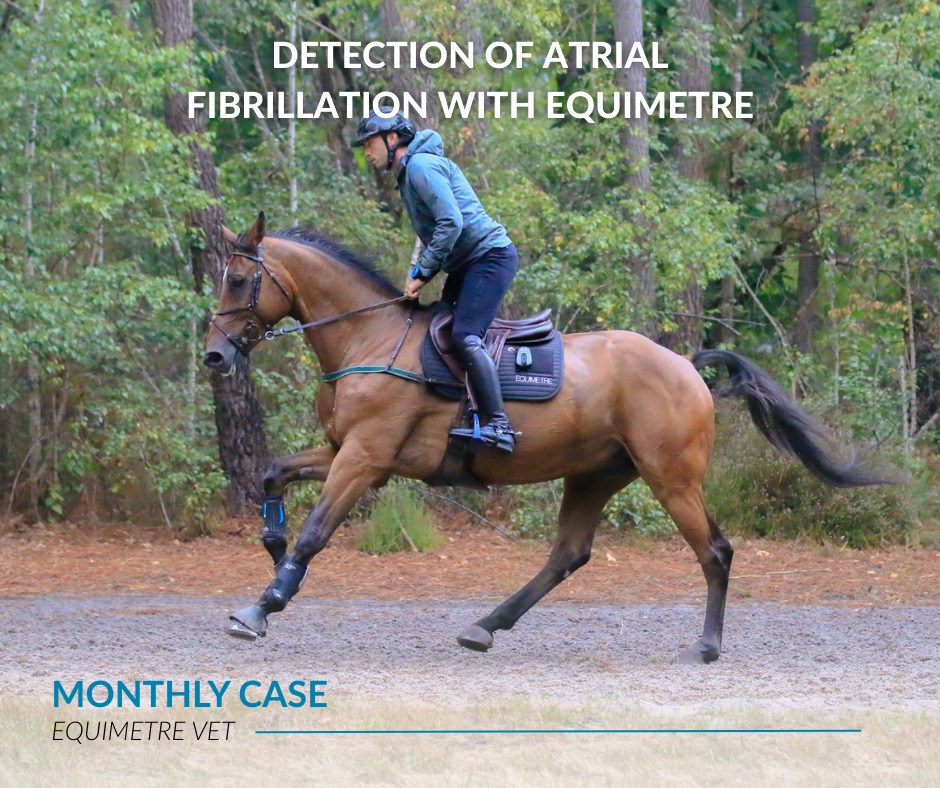
Meet Arion, a 4-year-old thoroughbred gelding. Following an abnormal ECG during exercise, he was referred for a veterinary evaluation. An atrial fibrillation was identified and later confirmed by further exams.
Longitudinal monitoring with Equimetre allowed an early and precise diagnosis, leading to adapted management and improved welfare for the horse.
An example of a case involving the detection of atrial fibrillation using the Arioneo Equimetre Training System: here.
Non-exhaustive table
| Condition | Silent at rest? | Equimetre data | Risk if undetected |
| Atrial fibrillation | Usually yes | ECG: irregular rhythm at effort | Sudden death |
| Extrasystoles | Sometimes | ECG: premature QRS complexes | Serious arrhythmia if ignored |
| Overtraining syndrome | Subtle / progressive | Elevated resting HR + declining HRV | Career compromised |
To find out more about identifying and interpreting each type of arrhythmia on an ECG, take a look at our guide to the main cardiac pathologies.
2. Locomotor conditions
Orthopaedic conditions are the leading cause of career interruption and euthanasia in racehorses. Musculoskeletal injuries account for a significant proportion of lost training days. At top speed, the forelimbs absorb forces equivalent to 2.5 times the horse’s bodyweight, forces that accumulate session after session. The problem: the condition does not cause lameness straight away. A failing tendon, a forming stress fracture, these develop silently over weeks.
Science has demonstrated this (Pfau et al., 2019): a horse beginning to suffer a tendon problem makes very slight adjustments to its footfall and shortens its stride. These micro-changes, invisible to the naked eye, are captured by the Arioneo Equimetre Training System’s accelerometers. The progressive deviation in symmetry and stride length at a fixed speed, relative to the horse’s individual baseline, is the most valuable early warning available
| Key data: The re-injury rate for superficial digital flexor tendon injuries reaches 40 to 80%. The primary cause: returning to work too soon, without objective confirmation that the limb is ready. Data allows the return to training to be validated against measurable criteria alongside intuition |
“The tool proved indispensable following an injury to one of my horses in a race. I now use it to detect the subtle signals that precede an incident, which allows me to get ahead of problems rather than react to them. It is a unique point of reference: after his convalescence, I was able to compare his comeback data with his previous performances to fine-tune his return to work with precision.”
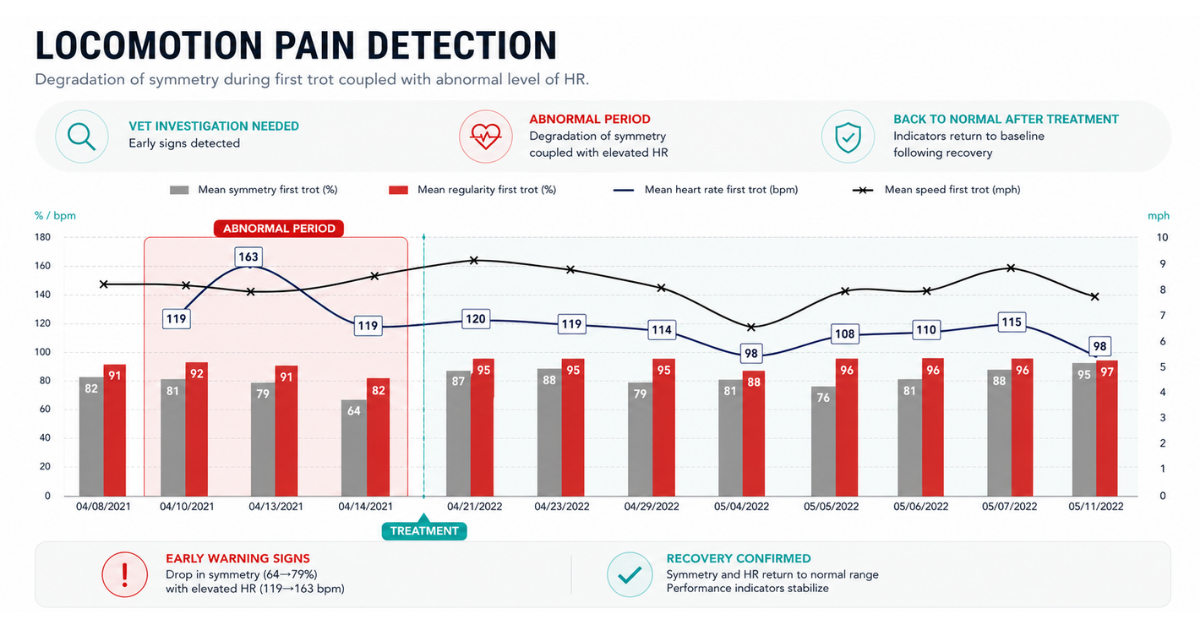
Example of a case where the horse had a gradual loss of symmetry prior to the injury:
Non-exhaustive table
| Condition | Silent phase | Equimetre data | Risk if ignored |
| Tendinitis | Weeks to months | Stride shortening, propulsion asymmetry | Complete rupture |
| Desmitis (suspensory ligament) | Weeks | Increasing lateral asymmetry, weight-bearing variation | Tear, chronic lameness |
| Stress fracture | Days to weeks | Compensatory asymmetry, reduced top speed | Catastrophic fracture |
| Early-stage osteoarthritis | Months to years | Stiffness, progressive asymmetry | Irreversible degeneration |
| OCD / Bone fragmentation | Silent until fragment displacement | Sudden symmetry change, altered recovery | Emergency surgery, uncertain prognosis |
3. Respiratory conditions
When galloping, a horse moves up to 12 litres of air per breath, up to 150 times a minute. Respiratory conditions are the most difficult to detect: the horse does not necessarily cough, shows no blood at the nostrils, and often continues to perform, just less well, but not poorly enough to trigger investigation.
Up to 75% of Thoroughbreds present with exercise-induced pulmonary haemorrhage (EIPH) after intense effort, and in the vast majority of cases no blood is visible externally. More than half of Thoroughbreds in training have mucus in their airways. A horse that is compromised in this way must work harder: its heart rate climbs higher than usual to compensate for the oxygen deficit, and it is precisely this signal that the data captures.
| Key data: a heart rate that is abnormally high for a known workload, or a recovery that is taking longer than usual to return to normal at 15 minutes post-effort, indicates a respiratory condition, even in the complete absence of visible clinical signs. |
Non-exhaustive table
| Condition | Silent phase | Equimetre data | Risk if ignored |
| Pulmonary haemorrhage (EIPH) | Systematic | HR slow to return to normal post-effort | Pulmonary fibrosis, reduced VO₂max |
| Equine asthma (IAD) | Often (no cough) | HR abnormally high for the workload | Chronic obstruction, underperformance |
| Roaring / Soft palate displacement | No (audible) | HR profile inconsistent with speed | Sudden airway obstruction at effort |
| Respiratory overtraining | Yes | Degraded recovery | Global exhaustion, immune fragility |
4. Detecting, anticipating, monitoring
Physiological data does not have a single value, it has three, depending on the moment at which it is used.
Detection means capturing an anomaly as it occurs: an atrial fibrillation on the ECG during a gallop, a clear gait asymmetry in a session. Without monitoring, these anomalies occur and are never recorded.
Anticipation relies on comparing a current parameter against an individual historical baseline: a repeated reduction in symmetry during the warm-up trot, a stride that is gradually shortening, a recovery curve that is taking progressively longer. These signals precede clinical expression, but they are invisible without longitudinal tracking.
Monitoring objectively validates recovery: has symmetry returned to its original value? Has cardiac recovery returned to normal? Rather than relying on an impression, the data confirms it.
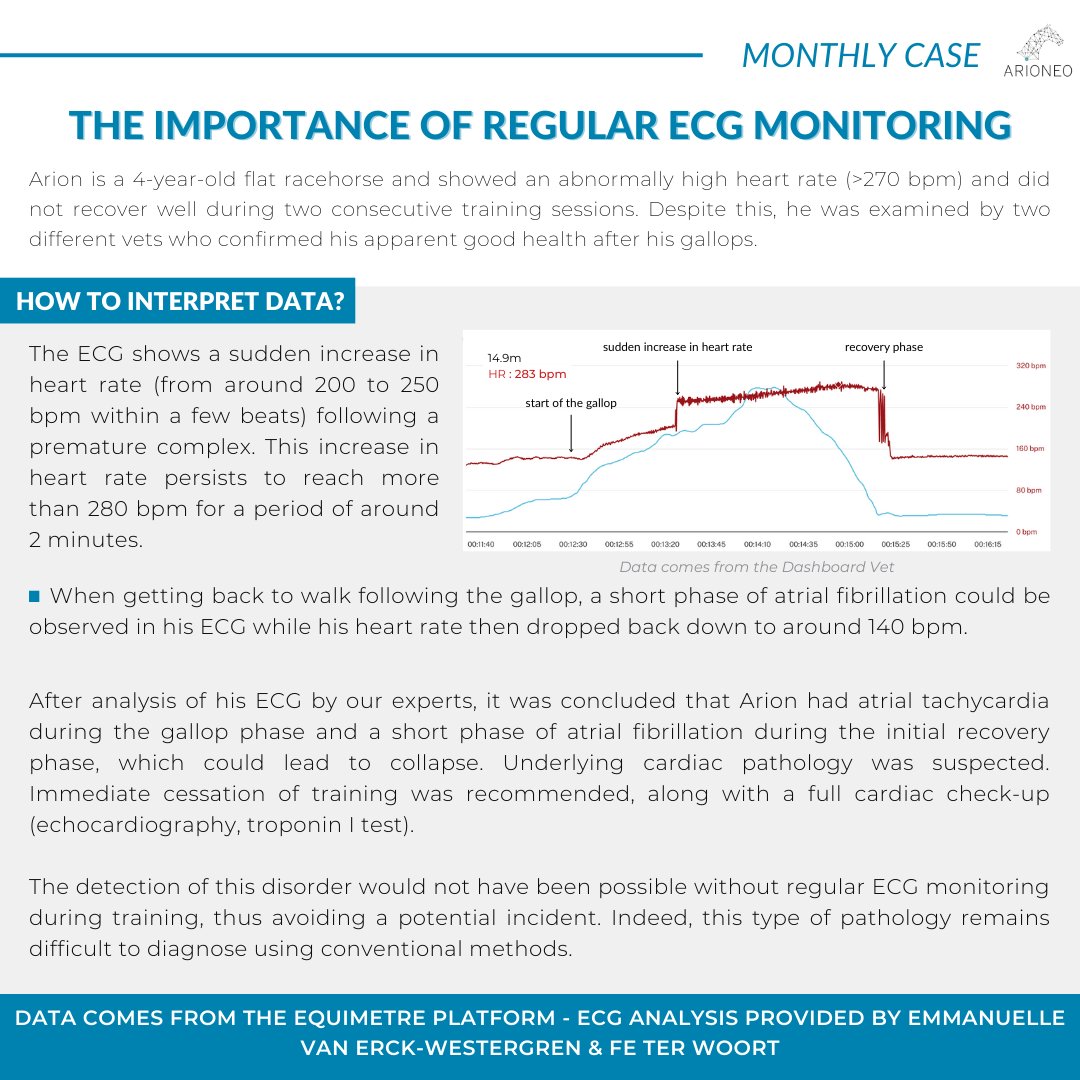
Arion is a 4-year-old flat racehorse and showed an abnormally high heart rate (>270 bpm) and did not recover well during two consecutive training sessions. Despite this, he was examined by two different vets who confirmed his apparent good health after his gallops.
An example illustrating the importance of regular ECG monitoring using the Arioneo Equimetre Training System: click here.
| Mode | Example | Data used |
| Detection | AF identified during a gallop | ECG at effort |
| Detection | Clear gait asymmetry | Symmetry + stride length |
| Anticipation | Asymmetry drift → tendon lesion | Symmetry trend across multiple sessions |
| Monitoring | Return to work after tendon injury | Symmetry vs pre-injury baseline |
| Monitoring | Efficacy of asthma treatment | HR + post-effort recovery |
Conclusion
The real shift is from reactive medicine, which waits for clinical expression, to continuous, predictive medicine, where every training session is an opportunity for observation and every deviation from baseline is an early warning. The Arioneo Training System does not replace the vet or the trainer’s instinct: it amplifies both, by turning impressions into measurable evidence.
Adopting this approach is giving every horse the best possible chance of a long, healthy, and successful career.
Sources
- Pfau et al. (2019). Limb loading asymmetries in Thoroughbred racehorses. PLOS ONE.
- Smith, R.K.W. (2008). Tendon and ligament injury. Equine Sports Medicine and Surgery. Saunders.
- Hinchcliff et al. (2005). Exercise-induced pulmonary hemorrhage. JAVMA.
- Reef et al. (2014). Cardiovascular Abnormalities in Equine Athletes. JVIM.
- Valberg, S.J. (2018). Muscle Conditions in Sport Horses. Vet Clinics Equine.
- Cottin et al. (2010). Heart rate variability in horses. Research in Veterinary Science.
Key words: Arioneo, Training System, data, training, data analysis, horses, recovery, heart rate, speed, racehorse, safety, medical conditions, sudden death, racing, welfare, cardiac, atrial fibrillation, early detection, monitoring, equine tendonitis, ECG, thoroughbred, monitoring