
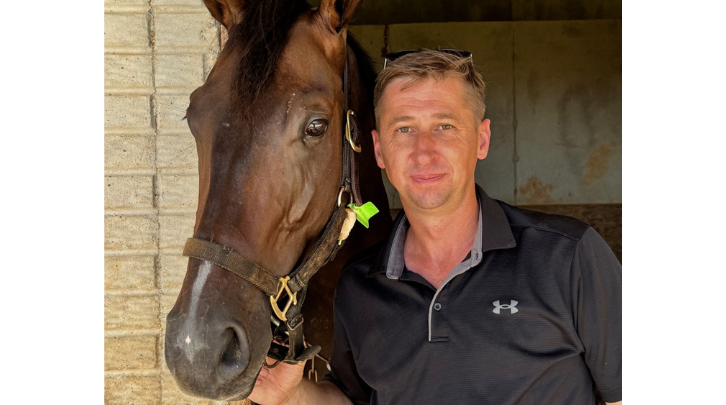
Based at Laurel Park in Maryland, racehorse trainer Niall Saville has incorporated EQUIMETRE into his daily training program. He uses objective data to adjust workloads, monitor fitness, and reduce the risk of injury. In this interview, he talks about his career, his training philosophy, and how data has changed the way he prepares his horses for races.
Watch the interview: link.
Could you please introduce yourself and tell us a bit more about your background as a racehorse trainer?
My name is Niall Saville. I’m a racehorse trainer based at Laurel Park in Maryland, and I’ve been around horses my whole life.
Both of my parents were horse people. My mother was a jockey, and my father trained horses and also competed in show jumping. I moved to England about 18 years ago, and I’ve been training racehorses for around 12 years.
How would you describe your philosophy as a trainer?
I try to get the best out of every horse we have. Every horse is different, so I train them as individuals.
Whether it’s a low-level claimer or a stakes horse, my goal is the same: to get the maximum out of each one. That’s the approach I take every day.
How did you first hear about EQUIMETRE, and what convinced you to integrate it into your training program?
My main client, Martin Somers, suggested that we try EQUIMETRE. Once we’d been using it for a few weeks, we really started to see the value in it, and from there we naturally began using it more and more.
Which tools or metrics have been the most useful for you?
It’s not so much one specific tool — it’s more about the overall picture the data gives us.
What I’ve found most useful is understanding that different horses need different types of work to get them to the races. Seeing how quickly they recover from their breezes, how sound they are, how consistent their strides are, and how they handle the track — all of that together is incredibly valuable.
How often do you use EQUIMETRE in your training routine, and how do you organize the data analysis afterward?
We use EQUIMETRE for every breeze. Some horses breeze weekly, others every two weeks, but they always wear it for those workouts.
It’s the first thing we look at. We’re so used to having it now that it’s become part of our routine. If we want to dive deeper into something later, we can review the data in more detail. But as soon as a horse finishes breezing, I check the data to see how he went.
Have you ever modified a training plan based on the information provided by EQUIMETRE? Can you share a specific example?
Yes. I really think it’s made me better as a trainer.
I’ve learned that some horses don’t need to stay on a strict breeze schedule every seven or ten days if they’re already fit. EQUIMETRE has helped me identify when a horse is at peak fitness, and I’ve adjusted training programs accordingly — avoiding breezing just for the sake of it.
It gives me more confidence, because I know the horse is truly fit and ready. That’s probably the biggest change I’ve made so far.
Do you think objective data analysis helps reduce the risk of injury? Why?
Yes, without a doubt — and it’s something we’re still improving at. We’ve been using EQUIMETRE consistently for at least two years now.
We’re starting to recognize changes in stride patterns or stride frequency. If a rider comes back saying something feels slightly off, but we can’t see it with the naked eye, we go straight to the data.
Catching small issues before they turn into major problems is better for training, better for the sport, and it certainly makes my job easier.
Is there a memorable moment or key lesson you learned thanks to EQUIMETRE?
Yes. One of the biggest lessons goes back to realizing that not all horses need to train as hard. We had one horse that needed very little work to be competitive, while another required much harder training to reach a worthwhile level.
Another example happened last year, when we noticed small changes we couldn’t quite explain. My owner took a closer look at the data and spotted changes in stride pattern and frequency. That led us to make a simple shoeing adjustment.
After that, everything returned to normal. It gave us the confidence to run the filly — and she ran very well. Those experiences really made me a believer. I think it’s made all of us better at our jobs.
Would you recommend EQUIMETRE to other trainers? Why?
Yes, I would — and I already have. Although, in some ways, I regret it a little because I thought we had an edge over everyone else.
But if you’re interested in training this way and want a deeper understanding of what your horses are actually doing, I would definitely recommend it.
Key words: Niall Saville, stable, Laurel Park, Equimetre, data, horses, analysis, racehorses, revolutionize, speed, recovery, trainer, comparison
Photo : Facebook