
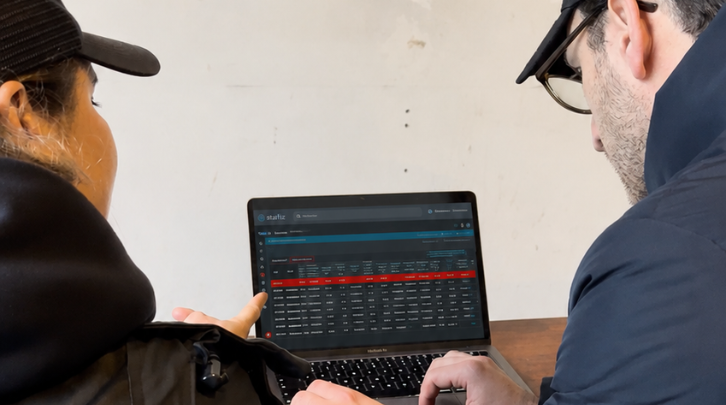
Just a few minutes after a gallop, your training report is already available on your phone. Heart rate, recovery, stride analysis, speed, sectional times and comparisons with previous sessions are automatically analysed, organised and ready to review or share.
Every morning, trainers make countless decisions. Should this horse’s workload be increased? Has it recovered well enough from its last piece of work? Is it ready to step up in intensity? How does it compare with the rest of the stable?
Experience will always be at the heart of good horsemanship. But when supported by objective data, it allows trainers to make decisions with greater confidence and precision.
That is the philosophy behind the Arioneo Training System. Beyond collecting data during exercise, the system automatically generates a range of reports designed to help trainers interpret each training session, monitor every horse’s progress and manage the performance of the entire stable. Each report answers a different question:
1. The post-training report: understanding every session
As soon as a training session is completed, an individual report is automatically generated for every equipped horse. It is available through the Arioneo mobile app, the web platform or delivered directly via WhatsApp.
There is no need to wait until you’re back at the yard to begin your analysis. Within minutes of finishing the gallop, the information is already available.
The report brings together all the key metrics from the session, including maximum speed, sectional times, heart rate, recovery, stride frequency and stride length. More importantly, it goes beyond simply displaying numbers. It helps trainers understand what those figures mean and how they can influence the next training decision.
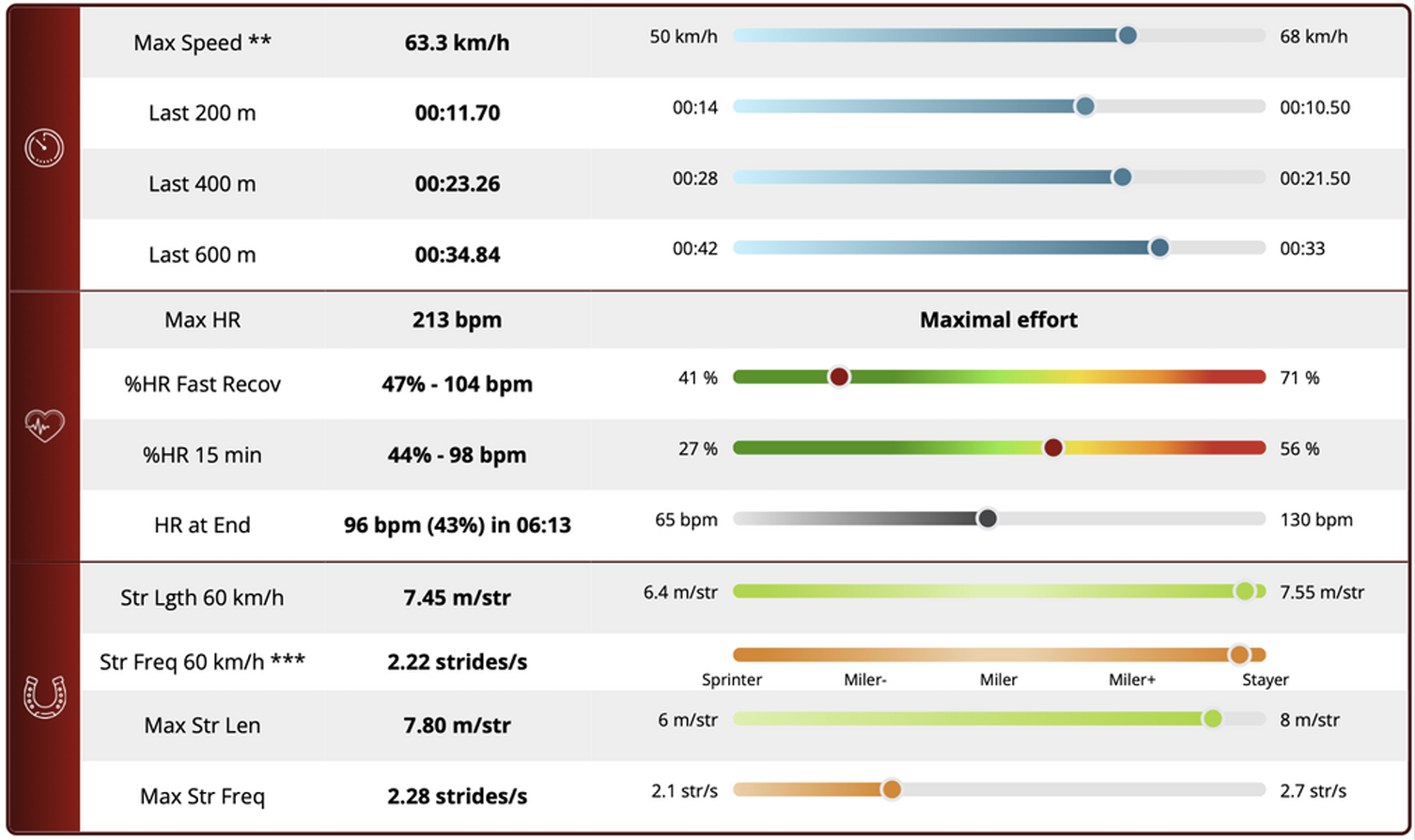
- Take cardiac recovery as an example. A horse may perform the same kind of work on two different days, but recover very differently each time. A slower-than-usual recovery may suggest reducing the workload during the next session, while a rapid recovery provides reassurance that the horse has coped well with the exercise and is ready to continue progressing.
- Stride analysis provides another valuable layer of information. Monitoring changes in stride length at a consistent speed can reveal early signs of muscular fatigue or locomotor discomfort before they become visible to the eye.
To make interpretation straightforward, the report includes colour-coded charts and performance gauges. Every value is benchmarked against the largest racing database in the industry, using country-specific references. Horses trained in France are compared with French racehorses, while Australian horses are benchmarked against Australian data, providing far more meaningful context than a generic global average.
Finally, previous training sessions are displayed alongside the latest report, making it easy to monitor long-term trends and identify changes in performance over time.
2. The post-training report: understanding every session
Understanding one horse’s session is only part of the picture. The next question is simple: how did that horse perform compared with the others?
The “Comparison of the day” report answers exactly that.
When several horses train together, all of their data is brought together in a single summary table. Speed, sectional times, heart rate, recovery and stride metrics can all be compared instantly.
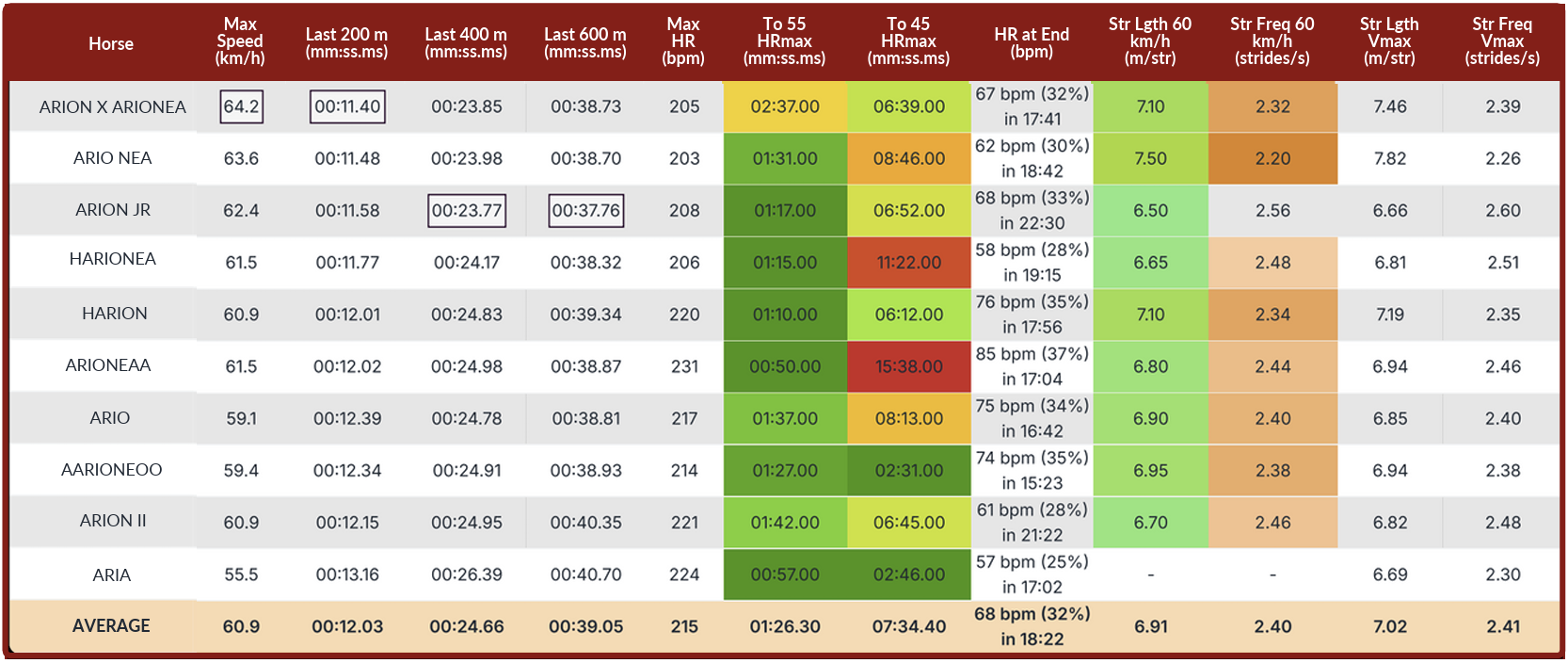
This provides a far more objective assessment than relying on memory or impressions alone. Two horses may complete the same gallop but produce very different profiles. One may continue accelerating through the final furlong, while another reaches its limit much earlier. The report immediately highlights these differences.
Sectional times, displayed every 200 metres, allow trainers to see precisely how each horse distributed its effort throughout the gallop. These insights help inform race planning, training programmes and future campaign decisions, while complementing the observations of both trainers and riders.
The Comparison report becomes a powerful benchmarking tool, built entirely on data collected under the same training conditions.
3. Stable review: managing the entire stable
Analysing an individual session is essential. Managing an entire stable requires a broader perspective.
The Stable review has been designed for exactly that purpose.
Covering a selected period, it provides a complete overview of the stable’s activity, highlighting important trends across the whole string. Number of training sessions, horses monitored, best performances and overall progression are all brought together in a single report designed to support management decisions.
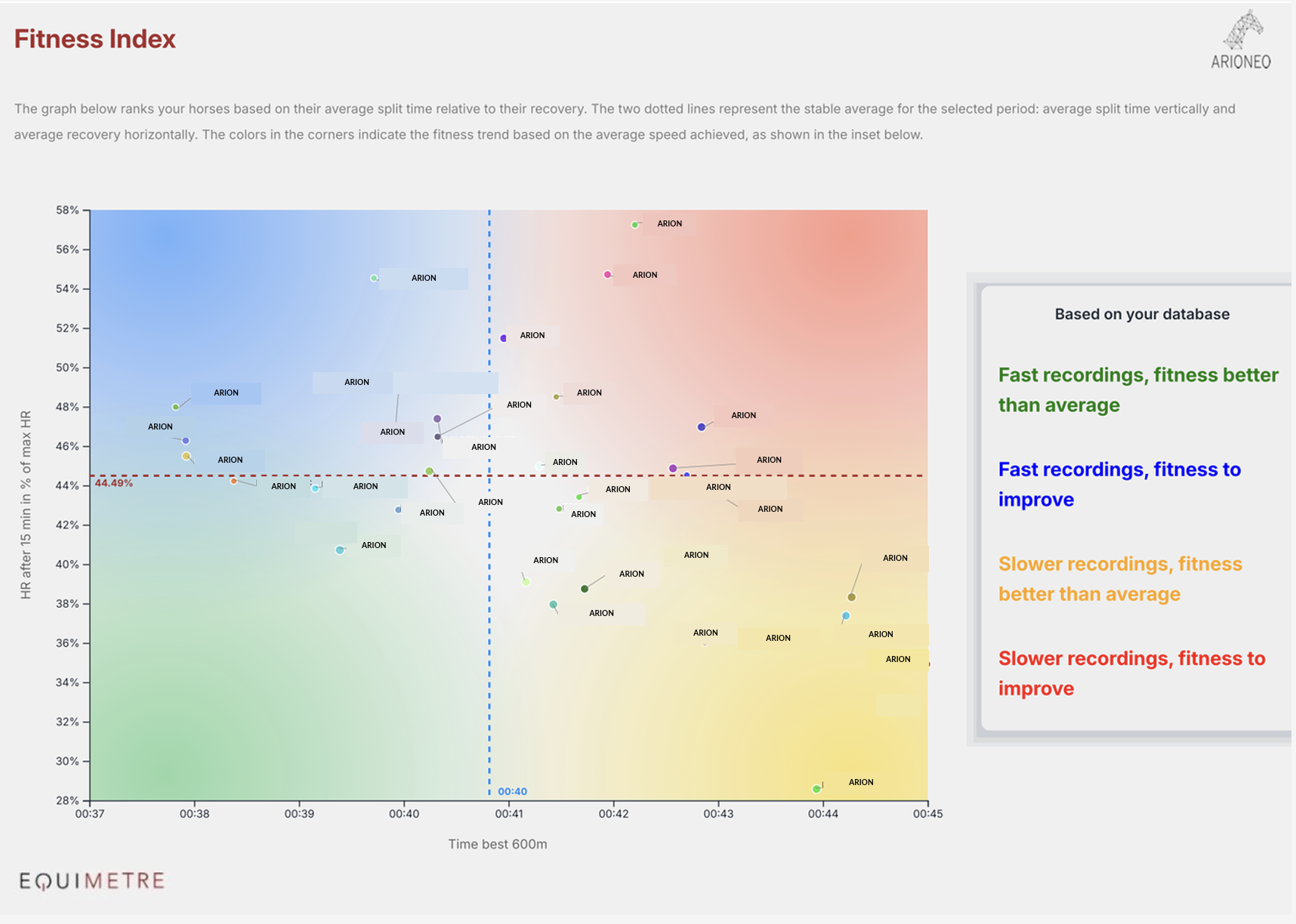
One of its most valuable features is the Fitness Index, which positions every horse according to two key indicators: performance and cardiac recovery. At a glance, trainers can identify horses that are thriving, those making steady progress and those whose workload may need to be adjusted.
The report also estimates each horse’s theoretical distance profile using stride characteristics compared to others. Horses with a higher stride frequency at a given speed tend to profile as sprinters, while longer, more efficient strides generally suggest greater aptitude for longer distances. These indicators provide valuable additional insight without replacing the trainer’s judgement.
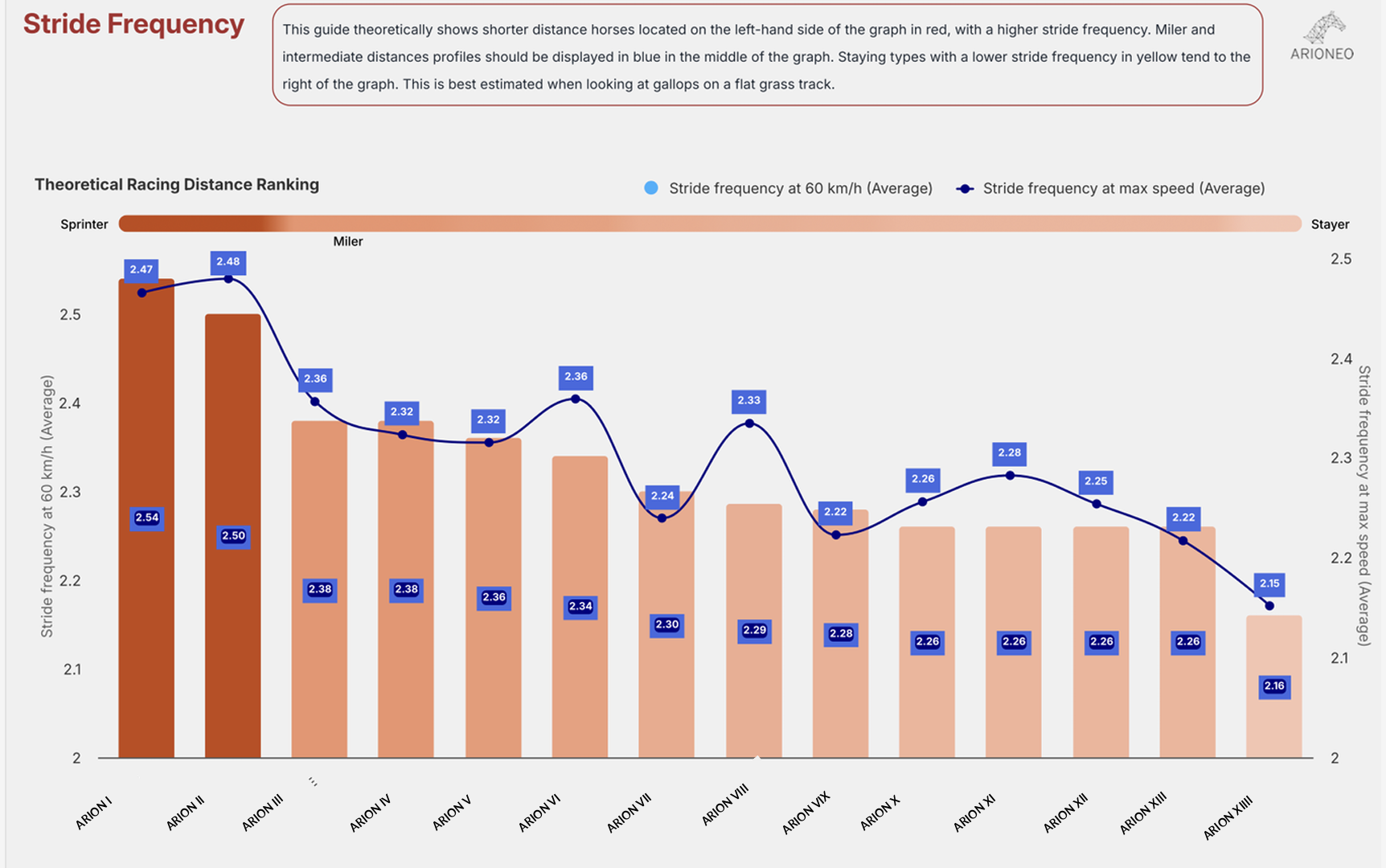
Finally, workload analysis by track, surface and exercise type helps trainers understand how the stable is being managed over time. Identifying that one track consistently produces slower speeds, or that certain types of work generate significantly higher workloads, allows future training programmes to be adjusted accordingly.
4. Strengthening communication with owners
Arioneo reports are not only valuable for internal analysis. They have also become an important communication tool with owners.
Through the platform, trainers can easily share reports with individual owners. Each owner has secure access to the data for their own horses only, ensuring complete confidentiality across the stable.
Rather than relying solely on verbal updates, trainers can support discussions with objective information: recovery trends, stride development, speed achieved and historical progress.
The data allows us to send weekly or monthly reports, depending on what the owners want. It’s a fantastic communication tool.
These reports improve transparency, demonstrate the work carried out at the yard and make it easier to explain decisions such as delaying a target race or adapting a horse’s programme. Many trainers also find that better communication strengthens owner confidence and generates valuable word-of-mouth recommendations.
5. In summary
Arioneo reports do far more than present training data. They organise it, place it into context and transform it into information that supports everyday decision-making.
– The post-training report helps analyse each training session.
– The comparison of the day report benchmarks every horse against its training partners.
– The stable review provides a long-term overview of the entire stable.
Together, these three complementary reports help trainers save time, gain objective insights and make more informed decisions while allowing experience and horsemanship to remain at the centre of every choice.
Interested in learning more?
Contact our team to arrange a personalised demonstration of the Arioneo Training System.