Horse performance data and the sociology of horse racing
Gwen Gérard took part in cohort 7 of the Advanced program. A PhD candidate specialising in the sociology of horse racing, she tells us how the training brought a concrete dimension to her research, and how she now sees herself as a bridge between theory and practice in the racing industry.
Could you introduce yourself ?
My name is Gwen Gérard. I am currently completing a PhD in the sociology of flat horse racing, focused on the human-horse relationship within a complex industry that remains under-documented by academic research. That’s precisely what drew me to it. I’ve been passionate about horses for as long as I can remember, and even though my professional path wasn’t built around them, I always found my way back. I also hold an MSc in Equine Science from England.
The further I go in my research, the more invested I become. It’s a field with real depth, often misunderstood by the general public, who tend to see it as a closed world.
What motivated you to join the Advanced program? How did you hear about it?
I discovered Arioneo through LinkedIn, most likely through a job posting. I looked into the company and immediately connected with its approach, innovative and rigorous, something I felt was missing in this sector.
The Advanced program appealed to me because it brought a concrete, data-driven dimension and gave me a new lens, grounded in data, that complements my own approach. It was precisely that complementarity that won me over.
The program met that need, even if there were a few concepts to catch up on at the start.
Your background is academic and theoretical. Is the program accessible to someone from that world, without direct field experience with data?
There’s a real learning curve at the start, particularly around vocabulary specific to the racing world. But with a solid understanding of horses and genuine motivation, you can keep up: the training stays centered on the horse itself, which gives everyone a common ground, whether they come from data or from the field.
What would you say is the main value the program adds to your day-to-day work?
It’s mainly this concrete dimension, and a new way of approaching the horse: giving it a voice, visibility into its condition and how it’s feeling. For my research, that’s essential. It’s a bit like having tangible evidence: the horse expresses itself, we can listen, and that confirms its place as a full-fledged athlete.
Can you share a specific example where the program had a positive impact, or a course that particularly stood out to you?
Thanks to my MSc in Equine Science, the anatomy and physiology side was already familiar to me. What struck me most were the key parameters and flash analysis: being able to follow a horse over time, cross-reference data, and compare training sessions. It’s a real goldmine of information, and I learned a great deal from it.
I also really appreciated the module on working with a racing team: a clear, pedagogical approach that explains how to navigate conversations with teams on the ground. A great complement to the technical side.
Your background is research and analysis-oriented. How do you see yourself translating these skills into the field?
I see myself as a bridge between the theoretical and the practical world. I enjoy building connections between worlds that rarely talk to each other. The Advanced program gives me that legitimacy, alongside my academic expertise, to make that link.

Given your background in horse racing sociology, how do you see the integration of data and sport science into traditional training practices?
It’s a field that’s evolving. Younger generations of trainers are increasingly open to using data, alongside their expertise and intuition, which remain essential. That shift takes time, but it’s real: data supports and validates what trainers already observe on the ground, which also helps shift the industry’s image.
I’m convinced that data, and the way we communicate about preparing horses the way we would athletes, can help build better understanding, and in turn stronger public engagement around racing.
If you had to describe the program in three words, what would they be?
Listening, because the knowledge gained helps you better approach the horse. Skill, because the program builds real analytical ability. And openness, because it broadens your perspective over the long term.
Our goal is to combine welfare and performance. Did you feel that in the program?
Completely, it’s obvious. The program never presents the horse as a mere performer or a means to performance. On the contrary, it encourages a deeper understanding and analysis of the horse, which connects to a concept that matters a lot to me: agency, meaning the horse-athlete’s real participation. Far from being a mere performer.
Can you tell us about your professional plans?
This training gives me added legitimacy to consider working with an innovative organization, at the intersection of human behavior and performance data. The exact role is still to be defined, since this kind of hybrid profile doesn’t really exist on the market yet. My goal is to help shift the way racing, and the racehorse, are perceived.
Would you like to add anything?
It was a truly enriching experience. I wish every trainer could have an Equimetre, it would change so much.
Thank you to Gwen for sharing her story.
To learn more about the Essentials & Advanced Programs to learn how these programs can enrich your career, please visit the page dedicated to the programs.
Keywords: Arioneo Institute, performance, advanced, program, training, Equimetre, health, Arioneo Institute, PhD, research, data, data analysis, athlete horse, racehorses
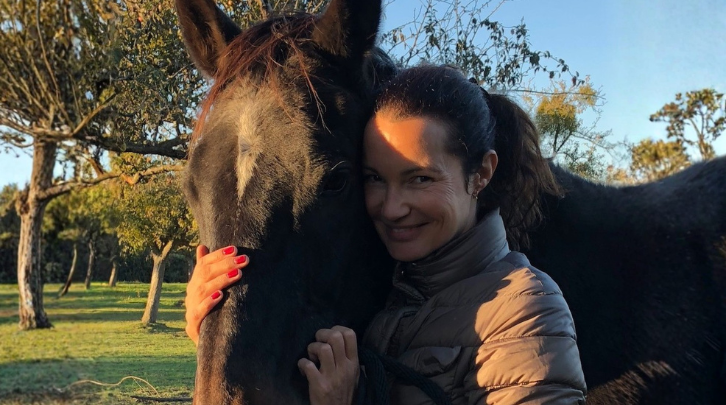
📸 Picture: Gwen Gérard