Arioneo announces the deployment of a new generation of automated ECG-analysis algorithms capable of detecting cardiac rhythm abnormalities, including atrial fibrillation (AFib), across training, racing and resting conditions.
Powered by an artificial intelligence engine trained on one of the largest exercise ECG datasets in the racing industry, this technology enables, for the first time, large-scale cardiac screening in racehorses under real-world conditions.
This marks a significant step toward systematic detection of exercise-related cardiac risk, a major but often underdiagnosed contributor to racehorse fatalities.
A documented but underestimated risk
Exercise-associated sudden deaths represent an estimated 20 to 25 percent of racehorse fatalities. Because most fatal arrhythmias leave no visible post-mortem signs, their true prevalence has long been underestimated.
Recent data from the Horseracing Integrity and Safety Authority (HISA) highlight a strong association between atrial fibrillation and sudden death during exercise, reinforcing the need for systematic cardiac monitoring in high-performance racehorses.
“Fatal arrhythmias are rarely identifiable after death. Without exercise ECG, they remain unseen. Systematic screening is essential for horses performing at high intensity.”
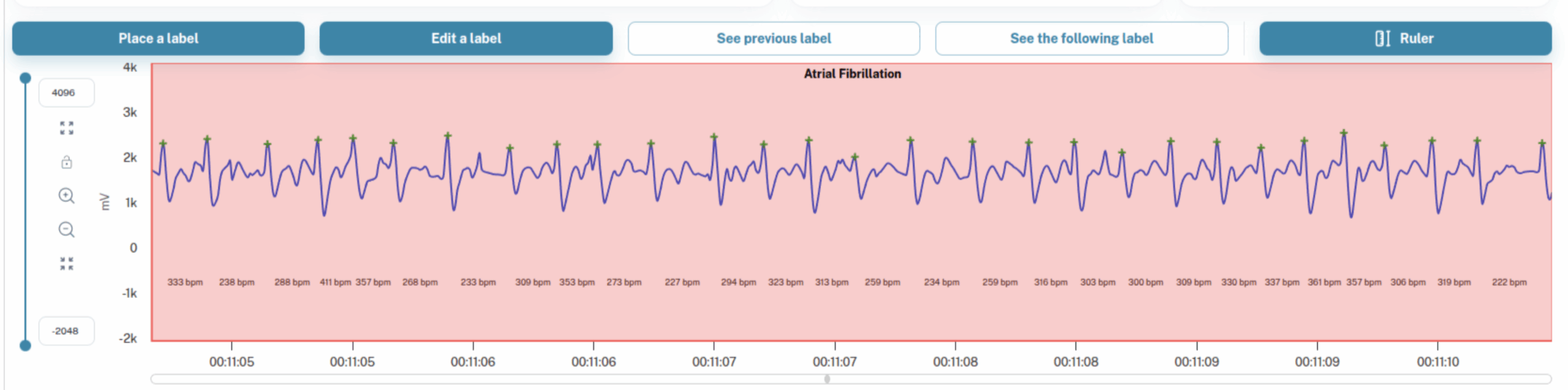
Example of an atrial fibrillation – Arioneo Vet Platform
Field-validated at maximal exertion
In collaboration with the Hong Kong Jockey Club, Arioneo has demonstrated that high-intensity ECG acquisition is feasible in real-world racing conditions. During barrier trials, the system successfully captured interpretable ECG signals at maximum speed and documented rhythm abnormalities occurring during peak effort.
Preliminary observations also indicate a clear association between exercise-induced arrhythmias and reduced performance, highlighting both welfare and competitive implications.
“High-intensity ECG monitoring in the field is no longer a technical barrier. The challenge is analysing data at scale.”
From expert analysis to scalable screening
Until now, exercise ECG interpretation required specialist expertise and significant time investment, limiting its use to isolated cases.
Arioneo’s automated analysis engine enables rapid screening of large volumes of data, identifying suspect cardiac patterns within minutes and prioritising cases for veterinary review. The system integrates advanced artifact filtering adapted to extreme motion conditions, ensuring reliable analysis during gallop, warm-up and high-intensity exercise.
A dedicated race-day solution
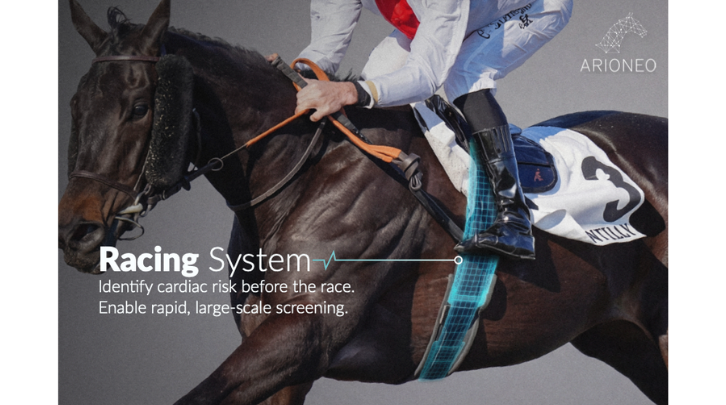
Arioneo is also finalising a new ultra-thin race-day girth integrating ECG electrodes and locomotion sensors that sits under the saddle cloth. This solution enables seamless cardiac and stride patterns monitoring without additional equipment, opening the door to pre-race screening protocols.
Enabling a new standard in racehorse safety
The combination of large-scale data acquisition and automated analysis now makes systematic cardiac screening operationally feasible across training and racing environments.
Racing authorities and industry stakeholders can now consider structured cardiac-risk management strategies, including:
- Implementation of exercise ECG screening in defined training populations
- Deployment of pre-race cardiac monitoring protocols
- Prioritisation of veterinary examinations based on objective alerts
- Longitudinal monitoring of horses presenting cardiac anomalies
- Integration of automated alerts into welfare and regulatory frameworks
Arioneo is opening pilot programmes in 2026 with racing authorities, racetracks and regulatory bodies.
“Exercise-related cardiac events remain underdiagnosed. Automation now makes systematic screening feasible at scale, improving both horse welfare and race safety.”
Key Words: Arioneo, Racing System, horse data, data-driven, training, analytics, horses, recovery, heart rate, speed, girth, racehorse, safety, screening, sudden-death, race, welfare, regulatory, cardiac, Atrial fibrillation, alert